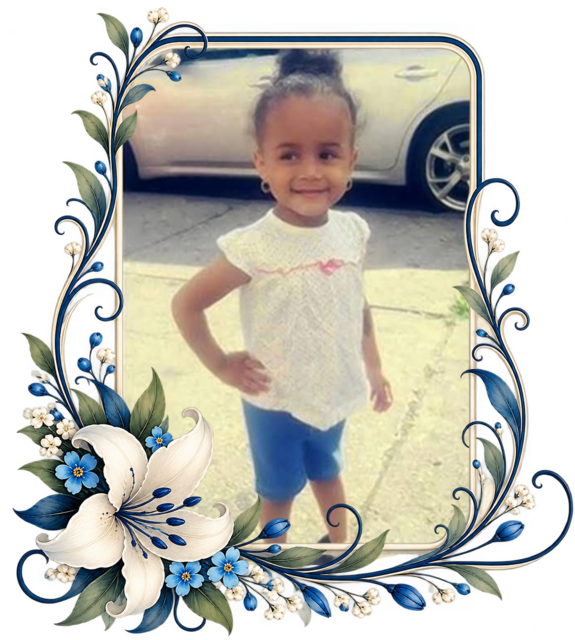
REMEMBERING JEIDA
Jeida Torres was only three years old when her life was taken on October 18, 2014, in Brooklyn, New York.
Jeida lived with her mother, Kimberly Torres, her five-year-old brother, Andrew Torres, and her stepfather, Kelsey Smith, in a family shelter in the Bushwick neighborhood.
Jeida and Andrew shared a close bond. Their uncle, Alejandro Hernandez-Torres, described the siblings as inseparable.
When Jeida was attacked, Andrew tried to protect his little sister, despite being only five years old himself.
Their uncle later spoke about Andrew's courage and the love he had shown for Jeida.
Those memories offer a glimpse of the little girl behind the headlines, a child whose relationship with her brother was an important part of her short life.
Jeida should have been growing up alongside Andrew, sharing childhood adventures, celebrating birthdays, and creating memories with her family.
Instead, she was killed by an adult who had been entrusted with caring for her.
Her death devastated her family and prompted questions about the safety of children living in New York City's homeless shelters.
Jeida was only three years old.
She deserved patience, kindness, and protection.
Jeida's Story
On October 18, 2014, Jeida and her five-year-old brother, Andrew, were at their family's residence inside a homeless shelter at 38 Cooper Street in Bushwick, Brooklyn.
Their mother, Kimberly Torres, was at work.
Her husband, Kelsey Smith, was responsible for watching the children.
That afternoon, Jeida had a bathroom accident and soiled her diaper.
According to investigators, Smith became enraged.
He began physically assaulting the three-year-old girl.
Andrew later told detectives that Smith kicked Jeida, struck her head against a bed frame, and choked her.
Investigators also reported allegations that Smith had humiliated Jeida over the accident before attacking her.
Andrew attempted to intervene to protect his younger sister.
Smith responded by punching and assaulting him as well.
The five-year-old boy suffered injuries and bruising but survived.
Jeida's injuries were devastating.
At approximately 3:50 p.m., Smith called Kimberly and admitted that he had struck Jeida and that she was no longer breathing.
Kimberly contacted police.
Officers responded to the family's shelter residence and discovered Jeida unconscious and unresponsive.
Emergency personnel transported her to Wyckoff Heights Medical Center.
Despite efforts to save her, Jeida was pronounced dead.
The New York City Office of the Chief Medical Examiner determined that she had died from blunt impact injuries to her head and torso.
Her death was ruled a homicide.
After the assault, Smith fled the shelter.
Investigators located him at a relative's residence in Queens, where he had injured himself in an apparent suicide attempt.
He was hospitalized and later taken into police custody.
Andrew received medical treatment for the injuries he suffered during the attack.
His account became an important part of the investigation into his sister's death.
Jeida had done nothing more than experience a bathroom accident, something entirely ordinary for a child her age.
She was punished with violence so severe that it ended her life.
Andrew, who was also a young child, was forced to witness the attack and suffered injuries while trying to defend her.
Jeida was only three years old.
She should never have been subjected to such cruelty.
Warning Signs and System Failures
Jeida's death raised significant concerns about child safety within New York City's homeless shelter system.
Following the killing, investigators and journalists examined Kelsey Smith's criminal history.
Police reported that Smith had approximately 15 prior arrests, including an assault-related arrest.
Additional reporting described earlier incidents of violence involving Smith while he was incarcerated.
However, the existence of a criminal history does not by itself establish that shelter administrators knew of every incident or had received a specific warning that he would harm Jeida.
Residents of the shelter also described hearing disturbances from the family's apartment before the fatal assault.
Some reported hearing adults arguing and children crying.
Those accounts raised concerns about whether warning signs of possible domestic violence or child abuse had been recognized.
The available reporting does not establish that those neighbors had previously submitted formal reports identifying abuse of Jeida or Andrew.
Following Jeida's death, New York City officials announced that the circumstances would be reviewed.
Mayor Bill de Blasio directed an examination of the city's multi-agency procedures, including domestic violence and child safety practices in homeless shelters.
The Department of Homeless Services and the Administration for Children's Services participated in reviewing the circumstances surrounding the case.
City officials discussed strengthening screening procedures for domestic violence and child abuse histories and improving risk assessments intended to protect children living in shelters.
Brooklyn Borough President Eric Adams also called for an investigation into whether existing safeguards could have prevented Jeida's death.
He raised concerns about the responsibilities of shelter personnel to recognize and report suspected child abuse.
These investigations and proposed changes reflected the seriousness of the questions raised by Jeida's murder.
However, the publicly available reporting does not establish that an official investigation ultimately found a particular shelter employee or child protective services worker responsible for failing to prevent the killing.
That distinction is important.
What is documented is that Jeida was killed inside a city-funded shelter, that her stepfather had a substantial criminal history, and that residents reported hearing earlier disturbances.
Her death prompted city leaders to examine whether the systems intended to protect vulnerable children were sufficient.
For Jeida, those questions came too late.
JUSTICE FOR JEIDA
Following Jeida's death on October 18, 2014, the New York City Police Department investigated the fatal assault.
Kelsey Smith was arrested after being located at a relative's home in Queens.
The medical examiner determined that Jeida died from blunt impact injuries to her head and torso.
Investigators also documented the injuries suffered by her older brother, Andrew.
Smith initially faced assault and child endangerment charges.
The allegations were subsequently expanded to include murder.
On November 7, 2014, the Brooklyn District Attorney's Office announced that Smith had been arraigned on a seven-count indictment.
The indictment included two counts of second-degree murder, first-degree manslaughter, second-degree assault, third-degree assault, and two counts of endangering the welfare of a child.
Smith was ordered held without bail.
The prosecution continued through 2015.
On October 23, 2015, Smith appeared before Brooklyn Supreme Court Justice Neil Firetog and pleaded guilty to second-degree murder in Jeida's death.
He also pleaded guilty to second-degree assault for attacking Andrew.
The guilty plea eliminated the need for a trial and formally established Smith's criminal responsibility for both crimes.
As part of the agreement, Smith waived his right to appeal.
The Brooklyn District Attorney's Office announced that the judge intended to impose a sentence of 15 years to life in prison.
Sentencing was scheduled for November 6, 2015.
Although the guilty plea and agreed sentencing recommendation are documented, the available official announcement does not independently confirm that the sentence was formally imposed on that date.
Kelsey Smith
Relationship to Jeida: Stepfather
Conviction: Second-degree murder and second-degree assault
Sentence: 15 years to life in prison under the announced plea agreement; final sentencing record not independently confirmed
FOREVER REMEMBERED
Jeida Torres was only three years old when her life ended.
Three years was not nearly enough time for her to experience the childhood she deserved.
She should have celebrated more birthdays, learned new things, made friends, and grown up alongside her older brother.
Jeida and Andrew shared a special bond.
When she was in danger, Andrew tried to protect her.
He was only five years old, yet he showed extraordinary courage and love for his little sister.
Their uncle remembered how close the two children had been.
That bond deserves to remain part of Jeida's story.
Following her death, a memorial appeared outside the Bushwick shelter where she had lived.
Pink balloons, stuffed animals, a doll in a cradle, and Hello Kitty items were placed in her memory.
Those small tributes reflected the childhood that had been taken from her.
Jeida was not simply the victim of a violent crime.
She was a little girl who had a family, a brother who loved her, and a future that deserved protection.
She should have been comforted after an ordinary childhood accident, not punished with violence.
She should have been safe with the adult responsible for watching her.
She should have had years of laughter, learning, and ordinary childhood experiences ahead of her.
Instead, her life ended at just three years old.
Her brother survived, carrying the memory of what happened and the loss of the little sister he tried so desperately to protect.
Jeida's death prompted public attention to the safety of vulnerable children living in shelters, but her legacy must be about more than investigations and policy discussions.
She was a child who mattered.
Her life deserved to continue.
Her name deserves to be remembered.
Abuse Angels remembers Jeida Torres.
Remembered. Honored. Never Forgotten.
