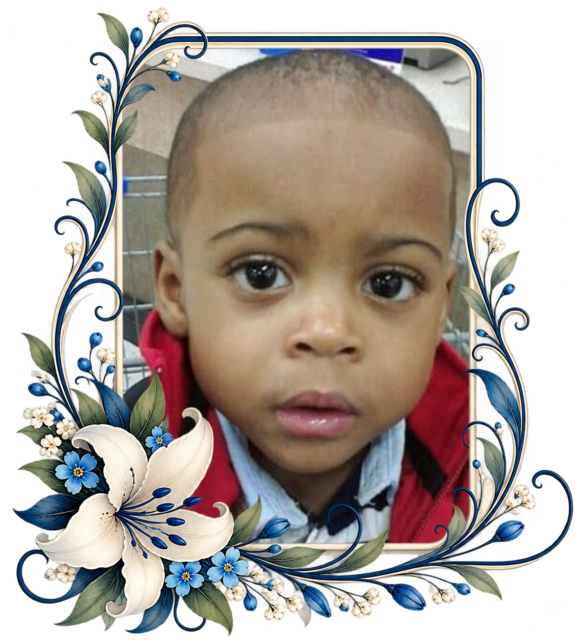
REMEMBERING ZAHREE
Zahree Thomas was only two years old when his life was taken on August 22, 2012, in Camden, New Jersey.
Zahree was a little boy whose family had spent much of his short life trying to ensure that he received the care and protection he needed.
He had an older sister, Shaterrah, and grandparents who loved him.
For extended periods, Zahree lived with relatives while his mother received treatment and support services.
His family worked with child welfare authorities in hopes of creating a safe and stable future for him.
In April 2012, Zahree returned to his mother's care following a court-approved reunification.
Just over four months later, he was killed inside their home.
His death shocked the Camden community and raised serious questions about the child welfare system's handling of his case.
But Zahree was more than the child at the center of those questions.
He was a son, a grandson, and a little brother.
He was only two years old, with an entire childhood still ahead of him.
He deserved to grow up surrounded by love, safety, and the opportunity to become whoever he wanted to be.
Zahree's Story
Zahree lived in Camden, New Jersey, with his mother, Chevonne Thomas.
His family had experienced significant difficulties involving his mother's substance use and mental health, and child protective services had been involved in his care since 2010.
During periods when his mother was unable to care for him safely, Zahree lived with relatives.
On April 3, 2012, following court proceedings and the completion of treatment and support services, Zahree was returned to his mother's custody.
The family continued receiving support and monitoring.
During the evening of August 21 and early morning hours of August 22, 2012, events inside their Camden home took a devastating turn.
A neighbor reported seeing Chevonne Thomas and her boyfriend sitting outside the residence earlier that evening.
The neighbor described Chevonne as visibly upset.
Shortly after midnight, Chevonne called 911.
During the call, she initially claimed that her boyfriend had stabbed Zahree.
She then withdrew that accusation and admitted that she had harmed her son.
Police responded to the family's home on Kaighns Avenue.
When officers entered, they discovered Zahree's body on the first floor.
The two-year-old had suffered multiple stab wounds and had been decapitated.
Investigators found his head inside the freezer.
As officers searched the residence, they realized that Chevonne was still upstairs.
Concerned about whether she was armed, police temporarily withdrew and established a perimeter around the home.
Officers later entered the second floor through a window.
They discovered Chevonne dead from a self-inflicted knife wound to her neck.
The deaths were investigated as a homicide followed by suicide.
An autopsy confirmed that Zahree had been alive when the fatal assault occurred.
His death was caused by the injuries inflicted upon him.
Authorities identified his mother as responsible for the killing.
Investigators also examined whether drugs had played a role in the events leading to his death.
Chevonne had a documented history of PCP use, but the available records do not establish that intoxication or a particular psychiatric episode caused the fatal attack.
He was far too young to understand what was happening or defend himself against an adult.
His life ended inside the home where he should have been safest.
Warning Signs and System Failures
Zahree's death occurred after nearly two years of involvement with New Jersey's child protective services system.
On November 28, 2010, authorities learned that Chevonne Thomas had left Zahree unattended in a parked vehicle.
Police subsequently located her in a public place while she was under the influence of drugs.
Chevonne acknowledged using marijuana and PCP.
The New Jersey Department of Children and Families substantiated neglect in connection with the incident.
Zahree was removed from his mother's custody and placed with a close relative.
He remained with relatives until July 11, 2011, when a court authorized his return after his mother completed substance abuse, mental health, and other counseling services.
However, the reunification did not last.
On August 2, 2011, Chevonne tested positive for PCP during a random drug screening.
Zahree was immediately removed from her care again and returned to the same relative.
Over the following months, Chevonne participated in additional treatment and support services.
These included substance abuse treatment, counseling, medication monitoring, parenting assessments, and therapeutic visitation.
The department reported that she subsequently produced consistently negative drug screens over an eight-month period.
On April 3, 2012, a court again authorized Zahree's return to his mother's custody.
The decision was supported by the parties involved in the child welfare proceedings.
Following reunification, the family continued receiving in-home services, therapeutic support, and assistance from relatives.
Drug screenings conducted in June 2012 were negative.
A child protection caseworker last visited the family on July 3, 2012.
On July 23, the department reviewed the case and began preparing it for closure.
Less than one month later, Zahree was dead.
Following his death, the New Jersey Department of Children and Families conducted a detailed review of its involvement with the family.
The department released its findings on December 7, 2012.
The review acknowledged that many aspects of the case had been handled appropriately, including the identification of Chevonne's treatment needs and the provision of services.
However, it also identified areas requiring improvement.
The department acknowledged a three-month period in late 2011 and early 2012 during which required contact with Chevonne had not occurred.
It also identified weaknesses in the coordination and interpretation of clinical assessments.
The review concluded that stronger internal clinical assessment capabilities and better integration of information from outside service providers were needed.
The New Jersey Child Fatality and Near Fatality Review Board also examined the case.
Its recommendations included improving the qualifications and reporting standards of contracted clinical professionals, evaluating the expertise of clinical consultants, and obtaining updated psychological assessments following reunification when appropriate.
The department subsequently described corrective measures involving supervision, clinical assessments, and forensic evaluation standards.
Importantly, the department's review did not conclude that child protection workers had received specific warnings that Zahree was about to be harmed.
Officials stated that their review had not identified evidence that staff knew Chevonne was in immediate distress or could have predicted the fatal attack.
That distinction matters.
The documented history establishes repeated concerns about Zahree's safety, two removals from his mother's custody, and a complex reunification process.
It also establishes that the department identified weaknesses in its own practices after his death.
But the available findings do not prove that an individual caseworker knowingly ignored an imminent threat.
Zahree's death demonstrated how difficult it can be to assess long-term safety when a family has experienced recurring substance abuse concerns and complex treatment needs.
The review prompted recommendations intended to improve how child welfare professionals evaluate and support vulnerable families.
For Zahree, those changes came too late.
JUSTICE FOR ZAHREE
Following the discovery of Zahree's body on August 22, 2012, Camden police and the Camden County Prosecutor's Office investigated the circumstances of his death.
Investigators determined that Chevonne Thomas had fatally attacked her son before taking her own life.
During her 911 call, Chevonne initially accused her boyfriend of harming Zahree but then admitted responsibility.
The medical examiner confirmed that Zahree had been alive when the fatal injuries were inflicted.
Chevonne was found dead inside the home from a self-inflicted knife wound.
Because she died before criminal proceedings could begin, there was no murder trial, guilty plea, or criminal conviction.
The investigation was treated as a homicide followed by suicide.
Authorities also reviewed Chevonne's earlier child endangerment case from 2010.
That charge had been dismissed in October 2011 after a witness withdrew the allegation concerning Zahree being left alone in a vehicle.
The dismissal of that criminal charge did not erase the separate child welfare finding of neglect or Zahree's subsequent removals from his mother's care.
The Department of Children and Families conducted its own review following Zahree's death and released findings and recommendations in December 2012.
Those proceedings addressed the handling of his child welfare case but did not result in a criminal prosecution concerning his murder.
Chevonne Thomas
Relationship to Zahree: Mother
Responsibility: Identified by investigators as responsible for Zahree's homicide
Conviction: None; died before prosecution
Case outcome: Death by suicide on August 22, 2012
FOREVER REMEMBERED
Zahree Thomas was only two years old when his life ended.
Two years was not nearly enough time for him to experience the childhood he deserved.
He should have celebrated more birthdays, learned new words, made friends, and discovered the things that made him happy.
He should have grown up alongside his older sister.
He should have spent holidays with his grandparents and created years of memories with the relatives who cared about him.
Instead, his life ended before he reached his third birthday.
Zahree's family was left grieving a little boy they loved.
His grandparents spoke publicly about the pain of losing both their daughter and grandson.
His sister struggled to understand how such a devastating tragedy could have happened.
The Camden community also mourned Zahree.
Neighbors gathered, counseling services were offered, and a memorial of teddy bears and toy cars appeared outside the home.
Those small toys were reminders of the little boy at the center of the tragedy.
Zahree was not simply a child welfare case.
He was not a statistic or a name in a government review.
He was a little boy who deserved safety, stability, and love.
His mother's documented struggles with substance use and mental health were part of the circumstances surrounding his life, but they do not diminish the responsibility to protect him or explain away the violence that ended it.
Zahree deserved the chance to grow up.
He deserved to be protected when he was vulnerable.
He deserved a future that extended far beyond August 22, 2012.
Although his life was heartbreakingly short, it mattered.
His name deserves to be remembered, and the lessons documented after his death should never be forgotten.
Abuse Angels remembers Zahree Thomas.
Remembered. Honored. Never Forgotten.
